The Art of the Prompt: Writing AI Instructions That Actually Work
Most people get poor results from AI because they ask the wrong way. Here are the principles that change everything.
The problem is almost never the AI
If you have ever used ChatGPT or Claude and thought "this sounds like a robot wrote it" or "this is not what I asked for at all" — the problem is rarely the AI. It is the instructions you gave it.
In the AI world, the instructions you type are called a "prompt." The skill of writing good ones is called "prompt engineering." You do not need to be a software engineer. You just need to understand how AI thinks: it is a highly capable, literal-minded assistant. Vague instructions get generic answers. Specific, structured instructions get high-quality work that saves you hours.
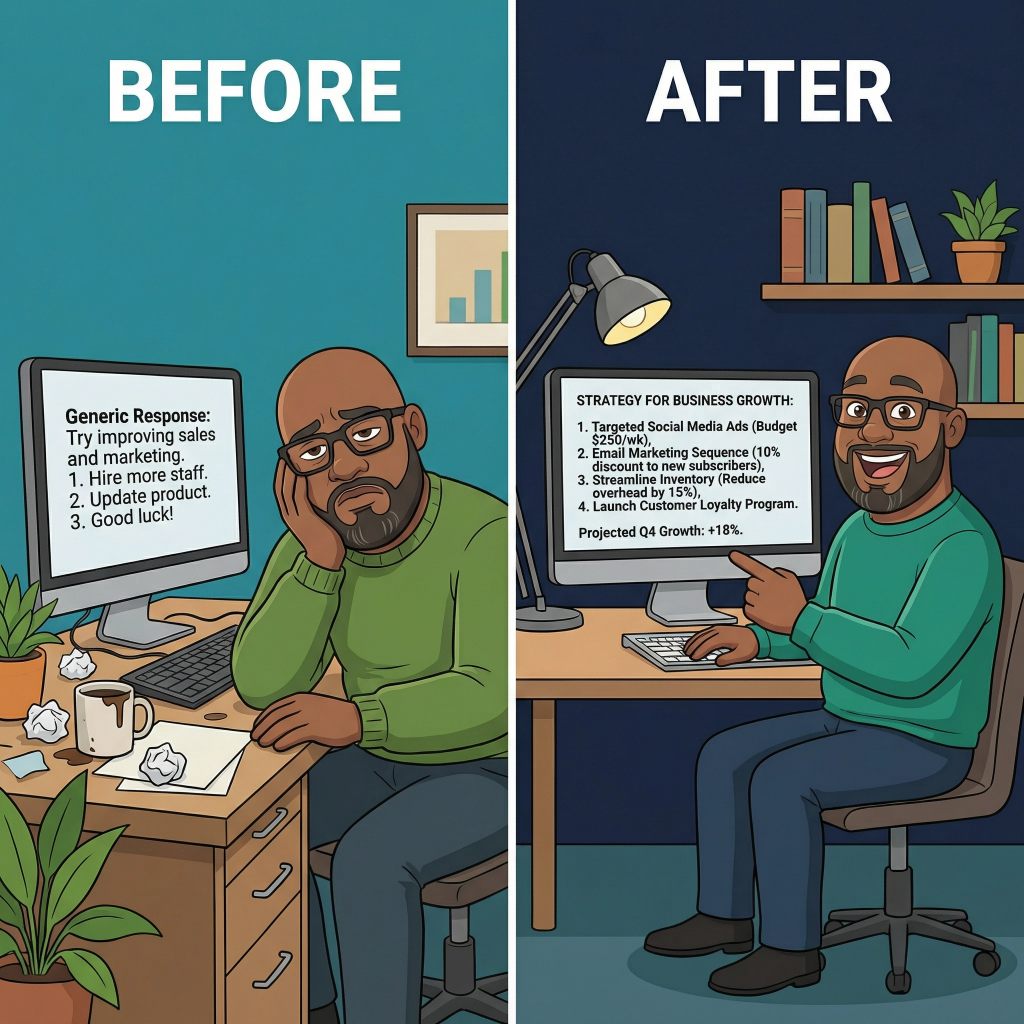
Bad prompt vs. good prompt
BAD PROMPT
"Write an email to a customer who is angry about a late delivery."
GOOD PROMPT
"I own a boutique coffee company. A customer named Sarah ordered our premium blend for a party but the package was lost. Write a warm, empathetic apology email explaining we are overnighting a replacement and offering a 20% discount. Keep it under 150 words."
The 5 core principles
Stop asking AI to "Write X"
Vague instructions get vague answers. Instead of "write a blog post about plumbing," give the AI the full picture: who you are, who it is for, what outcome you need.
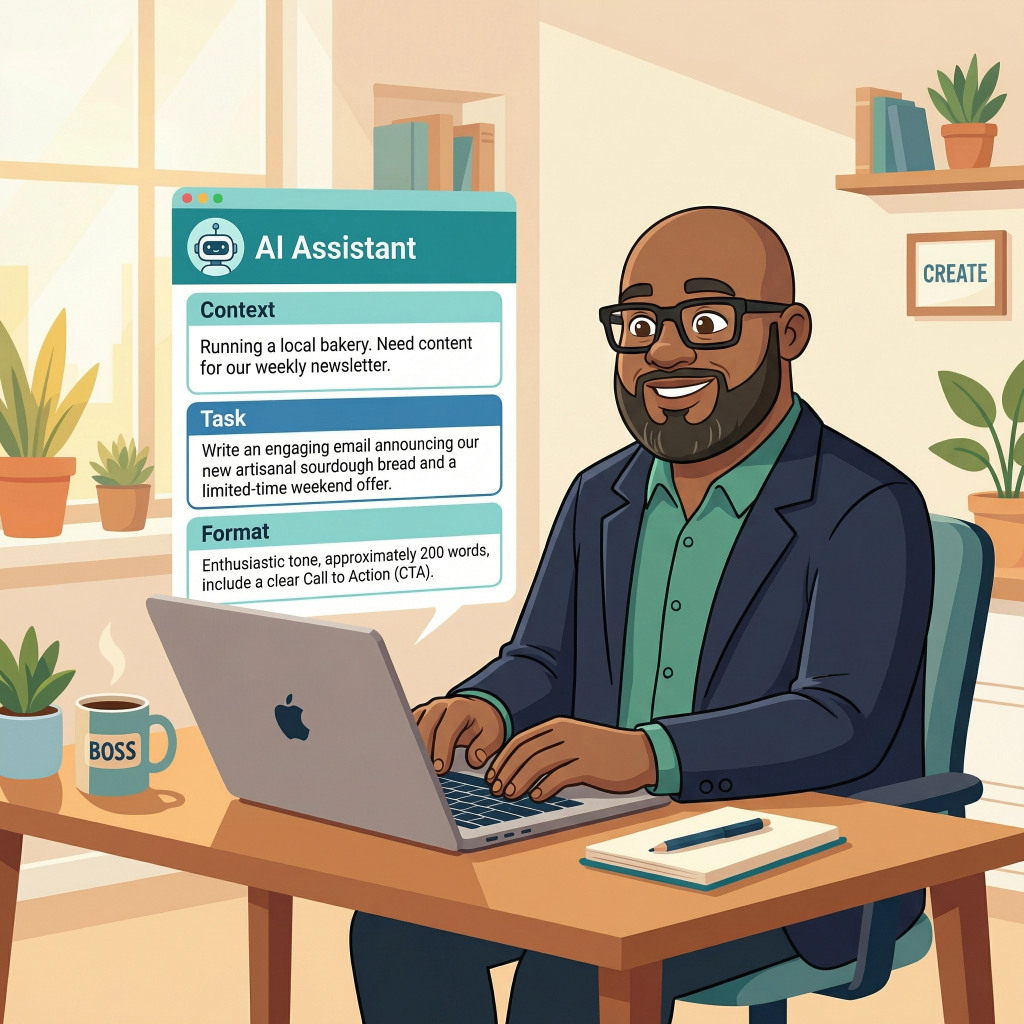
Use the Context + Task + Format framework
Every good prompt has three parts. Context (who you are and what the situation is), Task (exactly what you want the AI to do), and Format (how the output should look — bullet points, email, table, etc.).
Give the AI examples
If you want AI to match your writing style, paste in three examples of your best past work and say "write in this exact style." AI learns by example faster than by description.
Make the AI think step by step
For complex tasks, add "Let's think step by step" to the end of your prompt. This forces the AI to slow down, break the problem into pieces, and dramatically improves accuracy.
Assign the AI a role
Start your prompt with "Act as a [role]..." — for example, "Act as a senior marketing copywriter" or "Act as a patient customer support agent." The AI instantly adjusts its tone and approach.
5 real-world prompts you can steal today
Copy and paste these directly into ChatGPT or Claude. Just fill in the brackets with your own details.
The Explain My Business Prompt
"Act as a world-class marketing copywriter. I am going to describe my business in a few messy sentences. Rewrite my description into a single, punchy one-sentence elevator pitch that a 10-year-old could understand. Here is my business: [Insert your description]."
The Meeting Summarizer Prompt
"Here are the rough notes from a meeting I just had: [Paste notes]. Summarize these into three sections: 1) The main goal of the project, 2) The three biggest concerns raised, and 3) A bulleted list of action items, assigning each to either me or the client."
The Objection Handler Prompt
"I am selling a [product/service] for [price]. My target customer is [audience]. What are the top 5 reasons they will say no? For each objection, write a one-paragraph script I can use to overcome their hesitation."
The Content Multiplier Prompt
"Here is a blog post I just wrote: [Paste post]. Turn this into: 1) A 200-word LinkedIn post, 2) A short email newsletter intro, and 3) Three short Twitter/X posts pulling out the best quotes."
The Tough Love Consultant Prompt
"Act as a ruthless, highly experienced business consultant. I am going to paste my idea for a new product. Tell me the three biggest flaws in my logic, why it might fail, and what I am overlooking. Be brutally honest. Here is the idea: [Paste idea]."
The golden rule of prompting
Prompting is an iterative process. You will rarely get the perfect answer on the first try. That is completely normal. If the output is too long, reply: "Make it half as long." If it sounds too corporate, reply: "Rewrite this so it sounds like two friends talking at a coffee shop."
Treat the AI like a smart, eager intern on their first day. Give clear instructions, provide examples, and do not be afraid to ask for revisions.
Want personalised AI guidance for your business?
Our free AI Productivity Assessment gives you a personalised action plan showing exactly where AI can save you time and money.
Start Your Free Assessment